Transcript
Announcer:
You’re listening to DermConsult on ReachMD. This episode is sponsored by LEO Pharma Inc. And now, here’s your host, Dr. Charles Turck.
Dr. Turck:
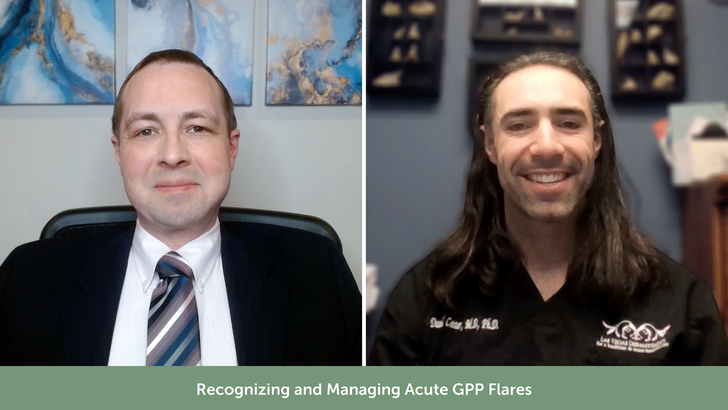
Welcome to DermConsult on ReachMD. I'm Dr. Charles Turck, and joining me to share practical strategies for recognizing and managing acute flares of generalized pustular psoriasis is Dr. David Cotter, who's a dermatologist at Las Vegas Dermatology.
Dr. Cotter, thanks for being here today.
Dr. Cotter:
Thank you, Dr. Turck. The pleasure is all mine.
Dr. Turck:
Well, to get us started, Dr. Cotter, when a patient presents with widespread skin findings and systemic symptoms, what clinical features should prompt us to suspect a flare of acute generalized pustular psoriasis rather than, say, a worsening of plaque psoriasis?
Dr. Cotter:
This can legitimately be a diagnostic dilemma, and that's the first call-out because when you look at textbook photos of GPP versus plaque psoriasis, a novice learner would say, "How could you not tell these two diseases apart?" But it can actually be a little more challenging in the real world.
A couple of points to anchor to are that GPP is characterized by diffuse sterile pustulation and often presents with systemic manifestations. Some of those manifestations include fever, malaise, fatigue, and even significant skin pain, which makes it a particularly scary disease state, not just for the patient but for the clinician because we're wondering, is this truly an inflammatory skin disease? Is this a severe drug reaction? Is this a severe infection? What level of care does this patient need? That said, early recognition is essential because the disease severity can absolutely escalate rapidly.
Dr. Turck:
Now, you mentioned infections and drug reactions. What laboratory findings and clinical clues might help us differentiate pustular psoriasis from some of those common mimics?
Dr. Cotter:
Thinking about it clinically first, it still starts with taking a history. We're still physicians, PAs, and NPs; we need to talk to our patients. You have to put their acute flare in clinical context with a solid patient history. The primary differential diagnosis is acute generalized exanthematous pustulosis or AGEP. But to have AGEP, there has to be a drug history. The trouble is with GPP, sometimes a medication can trigger that disease state as well, which is why we want additional markers to be evaluated. Sometimes our patients will have a leukocytosis and elevated inflammatory markers that accompany acute flares. However, that can also occur sometimes in patients with drug reactions. Our patients with GPP may have metabolic instability and even systemic involvement in severe cases. It's important to differentiate these different diseases in a timely manner, though. Otherwise, we're going to delay appropriate treatment for our patients.
Dr. Turck:
So once you've identified an acute flare, how do you quickly stabilize the patient and determine whether hospitalization is warranted?
Dr. Cotter:
The first step is to figure out whether I've got a sick patient or an unsick patient. Not every GPP patient requires hospitalization. Sometimes you can have a small flare. There's a lot of people who are walking around with low-level GPP activity, meaning that they might have a few pustules, they might have some erythema, and they're still itchy, but they're not in an acute flare where they're desquamating or having lakes of pus accumulating on their skin.
But anytime that someone may be approaching that tipping point, the answer is close follow-up. And if someone is turning the corner in the wrong way or they're already at that acute stage where they have lakes of pus on their skin, that's an inpatient admission. Sometimes these patients have insensible losses that result in things like a myocardial infarction. These systemic symptoms can be very severe. Fluid status becomes a big issue for these patients in terms of maintaining their overall clinical stability. And even though they're not infected from GPP, once your skin starts essentially falling off, you are at risk for an infection, which is why hospitalization may be appropriate for patients with significant systemic involvement or complications.
Dr. Turck:
For those just joining us, this is DermConsult on ReachMD. I'm Dr. Charles Turck, and I'm speaking with Dr. David Cotter about best practices for managing acute generalized pustular psoriasis flares.
Well, now that we've explored how we can recognize acute flares, Dr. Cotter, let's turn to treatment strategies. How has the therapeutic landscape for generalized pustular psoriasis evolved, and what role does targeted IL-36 pathway inhibition play in managing acute flares?
Dr. Cotter:
For so many decades in dermatology, we were off-label cowboys, meaning that we had lots of different medicines that weren't approved for certain conditions, and we had to play alchemist a little bit and mix and match to try to get our patients under control. Historically, for GPP, we've used anything from cyclosporine to acitretin to even off-label biologic medications that are approved to treat plaque psoriasis.
But in recent years, we've actually seen clinical trials dedicated specifically to GPP patients with therapies that are intelligently designed to mitigate the inappropriate inflammatory signaling that we see in these patients, which is centered on IL-36. The IL-36 pathway is overregulated. It's hyperactive in our patients with GPP, which is why bringing in targeted IL-36 inhibition has been efficacious to treat patients with GPP.
We're typically targeting our treatment selection based on the patient's disease severity, comorbidities, and clinical goals, some of which center on getting rapid control of an acute flare. But conversely, sometimes it's maintenance therapy. We can put patients on maintenance IL-36 inhibition to prevent acute flares as well.
Dr. Turck:
Now, Dr. Cotter, once a patient's flare has resolved, what are the most important next steps in the immediate follow-up period to monitor recovery and reduce the risk of recurrence?
Dr. Cotter:
The most important next step is a clean handoff between the acute care team, which sometimes doesn't even involve a dermatologist. It might be an emergency room doctor or an ICU physician or an NP or PA in the hospital. We need a clean handoff to transition that patient from the acute care setting to the outpatient dermatology clinic to a dermatology practitioner who feels comfortable and is willing to manage GPP longitudinally. Many of these patients are at risk for subsequent flares. They should be monitored, and some would likely benefit from ongoing maintenance therapy to prevent recurrence over time.
Dr. Turck:
And looking beyond that immediate recovery period, how should dermatologists approach the long-term management of GPP, and what role does a multidisciplinary team play in sustaining outcomes for these patients?
Dr. Cotter:
For me, the best outcomes for GPP patients are going to come from increased awareness across the house of medicine. We need our primary care providers, our ER providers, and our ICU providers to be aware of this disease state and know that it's more than just a one-off. It's more than just a drug reaction. Even patient-level education to help them understand their disease and the need for ongoing longitudinal care is essential to achieve the best outcomes. A lot of people, even in dermatology, don't realize that there's an option for maintenance subcutaneous therapy for GPP that centers on inhibiting the IL-36 receptor pathway. When you give patients those types of therapies, they're less likely to have a flare in follow-up.
Dr. Turck:
Great way to round out our discussion. And I want to thank my guest, Dr. David Cotter, for joining me to discuss the recognition and management of acute generalized pustular psoriasis flares. Dr. Cotter, it was great having you on the program.
Dr. Cotter:
Thank you, Dr. Turck. The pleasure was all mine.
Announcer:
This episode of DermConsult was sponsored by LEO Pharma Inc. To access this and other episodes in our series, visit DermConsult on ReachMD.com, where you can Be Part of the Knowledge. Thanks for listening!